William H. Gass is director of the International Writers Center at Washington University in St. Louis. He is the recipient of two National Book Critics Circle Award for Criticism and the Lannan Lifetime Achievement Award. The New Republic called Gass’ first novel, Omensetter’s Luck, “The most important work of fiction by an American in this literary generation.” And a reviewer for The Los Angeles Times Book Review called his latest novel, The Tunnel: “The most beautiful, most complex, most disturbing novel to be published in my lifetime.” The following interview took place at the International Writers Center in St. Louis, Missouri.
Chris Orlet: I’d like to start by asking where you first gained your love for books? Was it from a parent or a sibling?
William H. Gass: Books didn’t figure in my family very much. My father was an athlete, fundamentally, and a baseball coach. And then, because he was also a failed architect, he taught mechanical drawing. But he wasn’t bookish at all. However, my grandmother’s attic was full of old, old books – kids books mostly – Horatio Alger and The Motorboat Boys on the Columbia River. Series stuff and a lot of English novelists. In the summers we would go to North Dakota to visit her, and I would get in that attic and read everything in sight. That’s when the passion started. I was maybe eight or nine. But I didn’t own books. It wasn’t until early high school that I started collecting pocket books when they were a quarter each. Later I took some of my books with me in the Navy. I carted them all over the Pacific in a duffel bag.
CO: Do any of those titles stay with you?
WHG: Treasure Island was one. There were a few I picked up on the way. I picked up the Golden Bough in San Francisco waiting to ship out. And I found a pirated edition of Hemingway in Shanghai. And a pirated edition of Ulysses, which I still have. The sort of treasures that are probably worthless on the market. In Japan, I picked up a few Japanese books, so I finally started to mail some back because I simply didn’t have space aboard ship.
CO: Could you describe your library for us? How large is your collection and what do you enjoy collecting most?
WHG: My library is an accumulator’s library. I have one room in my house devoted to the French and one to the German. I live in a rather large house, thank God. One room is devoted to Latin America, one bookcase for the Irish, and so forth. I’ve quite a lot of books on Japanese, Chinese, Philippine literature. Since I’ve been to some of these places, I’ve gotten a line on what’s going on, and I buy what I can. The collection is largely in world literature – in translation, mostly. Then there is the philosophy collection, which I have slowed down on. I’ve run out of room, and, since my retirement [from teaching], I wasn’t so sure I’d being using new stuff. I also have a large criticism and linguistics collection. And my wife (the architect Mary Gass) and I have a huge architecture collection. I don’t know how many books I have. Certainly over fifteen thousand.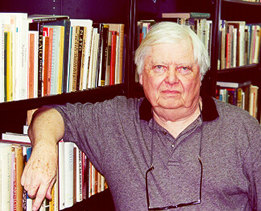
CO: What criteria go into choosing the books for your collection? Are you partial to first editions? Author signatures?
WHG: I’m not interested in that at all. First of all, I’m interested in cheap. I like to get bargains. But I’m basically interested in the text. It is very nice to have a good edition of the text, and it’s nicer yet if it’s older and valuable and a first edition, but it doesn’t make my heart beat faster to have a first edition. And I use my books. I work with them. Used for me is better – as long as it’s not broken to pieces. The more signs of previous ownership the better. I often pick up things for practically nothing that I don’t think I’ll ever use, but after fifteen, twenty years I usually end up getting some use out of them. I picked up this book on histology – it was fascinating, with all kinds of drawings of internal organs and such – and I needed a particular image for The Tunnel and got a cross section of the rectum out of it after maybe twenty years of having it around. So I believe in the off-chance.
CO: Where do you go to find books? Do you haunt used bookstores and book fairs, or do you shop online?
WHG: When we travel, my wife and I head for the used bookstores. The last time we were in Toronto we had to buy a couple of new suitcases to get all the books home. Toronto has a lot of wonderful bookstores. Germany, too. Though I don’t buy many German books because I don’t read the language that easily. But I’ll find books in English tucked away in odd corners. In the old days, I would visit places like the Goodwill.
St. Louis is not a good book town. We have one privately owned store that sells new and some used books, but the rest are these damn chains. We have a great book fair here every year in the parking lot right outside of this building. Even though I’ve been going for twenty-some years, we still come away with a hundred volumes each time. It’s the great cultural event of the year, as far as I’m concerned. Sometimes rare books pop up. Books have amazing lives. What brings first editions of Paul Valery’s essays in French to a book fair in St. Louis, I don’t know. It’s great treasure hunting.
CO: What do you enjoy reading most? One would think as a novelist your first love would be fiction.
WHG: I don’t read for enjoyment very much. Even when it’s things I would enjoy, because I’m usually working on an essay or I’m teaching the text. I like poetry best, or biography; I do re-read my favorite fiction writers, and I do keep up with some writers very faithfully. I’m pretty catholic about that though.
CO: Do you find that most fiction writers prefer to read something besides fiction?
WHG: Oh yes…for many reasons. One, the dismay at reading somebody so good that you feel devastated. For example, for a new book I’m hunting up sentences for analysis, and I run into, say, a sentence from Henry James. It’s a whole page. It’s so magnificently worked out that you think, “Oh, what the hell.” But it reaffirms the glory of the language. Second, there’s a lot of competition among some writers – I don’t feel that, but some do. And it gets in the way. There are many writers who get in your head, and you don’t want to read them while you’re working: Joyce, Faulkner, people with a strong style. It just diverts you.
CO: It could be said that one’s library is one’s personal statement of which literature should endure. From your perspective, what of literature needs to be preserved?
WHG: Everything needs to be preserved. If one were to collect in one way or another all the throw-away ads from supermarkets all over the country for five or six years and put them in a computer, you’d have a marvelous economic picture of the country. Everything is useful; somebody should be collecting everything. But there are some things that aren’t worth collecting more than once, like those throwaways from the supermarket.
When I was first getting really interested in books, I was at the University of Illinois, and they had a great library. Gordon Ray – head of the English Department at the time – was one of the great Victorian scholars. He’d done this massive biography of Thackery, but he’d also collected the garbage of Victorian libraries – all of the Victorian novels. They had everything. They didn’t even know what they had. There were many wonderful things that will turn out to be important later. If you’re studying the Victorian world – all of those bad Victorian novels is a way of studying that world. Ideally, libraries should just keep everything, though of course they can’t. But I never throw a book away. They’re sacred objects.
CO: Your books, like much of challenging literature, tend to live in the borderland between in-print and out-of-print books. Recently, the not-for-profit Dalkey Archive Press brought back into print two of your titles: Willie Master‘s Lonesome Wife and The Tunnel. In the future, do you think that such works will be published only by small, not-for-profit presses?
WHG: I think that’s happening now, and it will continue to be the case more and more. And I think that’s good because the people who are running those publishing houses care about what they are doing. It’s far better to have your book in the hands of people who care about it. It will be a marginal situation. One hopes that such presses will have enough people interested in the books to keep them alive and reasonably decently funded. That will happen – the serious things will end up in the small presses – and that’s fine. They put out nicer books on the whole, edit them better, care about them more, keep them in print longer. Their distribution is a problem, but I think that will be overcome by the Internet and other things. Of all of the links in the publishing chain, as I understand it, warehousing and mailing have been the problem for small presses. If that can be solved then I’m optimistic.
Odd things happen one never anticipates. Publishers publish books for reasons I do not understand. They don’t make any money on them, and they know it, and they are only interested in money. But still they publish them. And the books get remaindered quickly. I buy most of my books from remainder catalogs, more than I do in shops, and they’re brand new, cheap and wonderful books. Every Latin American translation ends up in a remainder house. All the translations. You just have to wait. I like my publisher Knopf; they’re wonderful to me, but I wouldn’t care if the whole bunch collapsed tomorrow. Real literature will be out there. But will people read it?
CO: E.M. Forster once said: “It is a mistake to think that books have come to stay. The human race did without them for thousands of years and may decide to do without them again.” You’ve become somewhat known as one of the Great Defenders of the Book. Is there something slightly desperate in having to defend books?
WHG: I wouldn’t bother normally. But people get worried about it because we live partly in a technological gadget-oriented culture, and there are all kinds of people who love gadgets and love the latest thing. But I have no particular devotion to the book in the sense that if something really better came along to do texts in, fine! But the present stuff is just gadgets, and it’s not better.
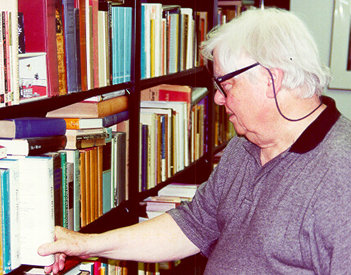
Certain technological objects, over the history of things, are simply as good as you can do with that sort of thing. You can make improvements to the bicycle, up to a point, but a bicycle is a superb technological object, and its advantages are so numerous. To say, `We’re going to replace the bicycle.’ With what? The horse? The motor car? Well, you can have the horse and motorcar, but you’re going to need the bicycle. The certain thing it does, it does best. A book is like that. The book form does its job wonderfully. It’s hard to imagine substantially improving on it. Like the bicycle.
CO: I can almost hear the manufactures of electronic or E-books protesting that they have improved on the form. After all, an E-book is the size and weight of a paperback, and contains a built-in dictionary. You can highlight passages, bookmark pages, search, browse and index references in ways impossible with paper books. Not to mention they solve the problem of storage and are a blessing on moving day.
WHG: I’ve looked at a few, and, first of all, the texts are terrible. But the whole problem with the way in which the text on a screen is presented is what’s crucial. Apart from the immalleability of the material, there is no sense of the simultaneity of the text. You can only see a small part of the text at one time. Trying to skim or hunt for something is extremely difficult and slow.
But even if they could overcome these problems, what they are still doing is imitating a book. When Ford came out with a motor car, he didn’t create a motorized horse. It was a different thing. Everybody said, “Well horses are done for,” but horses continue to prosper. So, this is a temporary aberration – people trying to make money out of gadgets. The best use I can imagine for them is reading in bed at night when you don’t want to disturb your spouse because the screen’s lit. But that lit screen is a disaster. The words have no substance. Part of it might be that we’re just used to books; maybe we could get used to this. But I don’t think that’s true.
CO: But if, as you have so often stated, it is the words that matter, why does the medium for those words matter so much? Or should that be a secondary consideration?
WHG: Oh, yes. If they could find a better way of presenting the words, in the sense of being able to really appreciate the words so that you get an intimacy with the text as it’s in your hand.
I did feel somewhat personal connection with my first typewriter, the way that some people feel connected to their cars, perhaps. But it is much harder to do. I just can’t fancy, in any other way, the close connection between the bearer and the text that you get with books. That’s a very important part of the experience of reading. Particularly as you’re growing up. But, the text is what matters as far as I’m concerned.
CO: Are you disturbed by the trend in online used bookstores like Alibris buying out the collections of independent used booksellers around the country? Or do you regard this type of competition from the Internet as a good thing?
WHG: Well, there are two sides to that question. The competition is good, if it makes available a bunch of used book titles quickly and easily for the reader who knows what he wants. But for the browser, for the whole experience of finding things, or sampling that whole experience of lots of books and a shop with knowledgeable help – you can’t get that with the Internet. And it drives those independents out of business. You gain certain things. If I have a title – I loaned my Malcolm Lowry title to somebody and never got it back – well, I want that book. Lowry is an important writer for me. So through some big Internet outfit I can quickly get it. That’s great. But if I’m discovering Malcolm Lowry, not a chance. And it’s very possible, certainly for a time, that Lowry was out of print. So I couldn’t find it in Books in Print. Only in used bookstores.
CO: What are your thoughts on the new electronic movement to make out-of-print books a thing of the past, whether through Web publishing where one downloads books from the Internet, or through Print-On-Demand where books are printed right at the bookstore in five minutes. These movements would seem a chance to offer books many people would like, but that are hard for traditional publishers to do profitably. How does the idea of never going out of print strike you?
WHG: I think this method is ideal for out-of-print scholarly stuff, but I think it’s over-rated for people who just want pleasure reading.
CO: To sum up, what is the status of the book today?
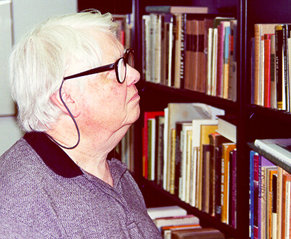
WHG: It’s never been better. There are more books being published, including more interesting books. The availability of books throughout the world is greater ever before. There’s more translating being done. (It’s always been bad, especially in this country, but it’s improving greatly.) And the art of making a book – there’s more interest in that. As soon as something looks like it may be dying, along come these people who want to make works of art out of it. We can’t get a press here at Washington University to publish new books, but we have a book arts division, studying the nature of the illustrated book and printing. Students are flocking to it and learning how to make beautiful books.
I remember when the novel was supposedly dead. It was a period when the novel was never better, during the 1960s. It was the greatest period for the novel ever. People said that painting would be hurt by photography, but, instead, painting got more and more serious, more and more outrageous. Now photography has become just another art form. So, no, I’m not worried.